Showing posts with label survival. Show all posts

Wednesday, November 14, 2012

Small game/ self defense bow

Here is a pic from a upcoming article on how to make a field expedient bow capable of taking small game and fish. This bow punches through a 3 layer cardboard target with 7 inches of penetration. In a must use scenario it could take out squirrels and rabbits and other varmint sized game as well as small fish provided you have enough string.

Wednesday, November 7, 2012

ALREADY AT IT!!

http://www.chicagotribune.com/news/sns-rt-us-arms-treaty-unbre8a627j-20121107,0,2655886.story

According to this article hours after the election the UN passed a vote to start talks about the Gun ban treaty back up in march 2013. Russia sadly was the only nation to oppose it. This is a clear stepping stone into our lives to allow the UN disarmament teams to come to your door and take your weapons. Once the UN has control of our guns there will be nothing stopping them to take control of our lives and government. If this treaty passes which it will Obama and Clinton already said they will sign it when it first came up earlier in the year I see a break out of Militias and possible civil war as the most likely option. This regime has been setting the stage to convince week minded sheeple that this will be a good idea from the start mainly with the Fast and Furious operations where THEY gave the firearms to CRIMINALS on purpose just to use it as a backing for this treaty! Don't let them fool you this regime is a cold calculating extremely smart one. Also the youth has been being indoctrinated with union lackey teachers to mold them into a complacent nanny government dependent nation. No nation especially Japan in WW2 would have dreamed of invading mainland America due to the armed civilian population which in a situation like that would be a HUGE force multiplier for the military but once the UN takes our guns it will be up to the government that gave them our guns and freedoms to protect us. By law of common sense is the most backasswards thinking you can have but unfortunately it is the thinking that has been ingrained in the coming of age generations. Buy now stock pile now and consider other options. Black powder has come a long ways since the 1800's takes no time to load and easy and cheap to stockpile necessary ammo and ammo can be forged when manufacturing stops. Bows and crossbows are cheap to maintain and stockpile needed supplies. A broad-head will penetrate light body armor with no problem and they are silent, not to mention you can make your own bolts easily. Live your life as normal in the day and in the shadows prep! DON'T let on to what you have and where you have it cached at! Join forces with a couple other preppers in your local area. work out a combined effort plan for O Shit scenarios, split the cost and work needed to be ready. More articles will follow in a series I plan on doing on prepping and steps needed as well as a tactical thinking article. 

Friday, August 10, 2012

Tuesday, July 24, 2012

Aquaponics set up

This is a rough markup of my future aquaponic set up. I am going to have a tub that will hold the fish and 2 grow beds. It will be a "Simple Flood and Drain" set up. I have a deep cycle marine battery that will run the system and I plan on buying a pump and some solar panels to maintain the battery so the whole system will be off the grid. As the water falls back into the fish tank just above the surface it will aerate the fish tank so no need to run a air stone 24/7. I plan on documenting this whole setup and posting here. Since my plan is to not have to pay for food after 3 years of being out of the army I want to start playing with different ways to save space and mass produce and this seems to be one of if not the best way to do so. I highly recommend on reading up on Aquaponics if you have not heard of it before. The website posted below is a good source to start at as well as YouTube. Look for this guys videos http://www.youtube.com/watch?v=HYR9s6chrI0 youtube name is "fishandveggies"...Oh yea almost forgot to mention the fish. I have not decided yet on what i want to grow as far as fish goes. but since I am trying to keep this whole project under $50.00 I might just go and catch some blue gills and try to transplant them.

Simple Flood and Drain

This is possibly the most simple method of setting up a flood and drain system. The grow bed sits above the fish tank, water is pumped from the fish tank into the grow bed, then the water drains straight back into the fish tank below. The ultimate in simplicity. If there's a problem with the pump or power supply the water drains straight back into the fish tank. This style of system is compact and has very few disadvantages, the only minor disadvantage is that the water level in the fish tank fluctuates when flooding the beds. Also the pump is in the fish tank so if it's only a small pump with limited solid pumping capacity, solid wastes may clog up the pump, requiring periodic maintenance. taken from http://www.backyardaquaponics.com/information/4-home/aquaponic-information/44-designs.html

Saturday, July 7, 2012

Natural Wonders by ~Rebecca McPhate


Blackberry brambles a nuisance?  Yaupon bushes unruly?  To some, these may be unsightly but, if you research your local native flora you may be really surprised and the unruly bush may suddenly become a treasured, more practical yard addition than maybe that imported, invasive species.  
The benefit of xeriscaping (the use of native plants in landscaping) not only saves a ton of time and money, but can also yield some other little-known pleasures.  Native species attract beneficial insects that kill off the invasive ones (yes, there ARE good bugs!) and most native plants have a natural resistance to drought.  If you enjoy butterflies many native plants can be used in place of a store-bought import.  When choosing your plants, develop a mentality like you would when shopping for material items – “Made in the USA”…better yet, narrow that down to regional.  There are many field guides and books in general that highlight invasive as well as native and better yet – the culinary uses of what may be found right in that unsightly weedy lot behind your house and most also have medicinal uses!  
The simplest of pleasures is a nice soothing hot drink after a long day.   When using the flora of your natural surroundings you also develop a better appreciation for the wonder of nature.  It is a great feeling when you can go out and enjoy what is naturally provided without even having to plant it, feed it or obsess over its care - also NOT having to buy from a grocery store.  Here are a few simple, most readily available things you can try today –
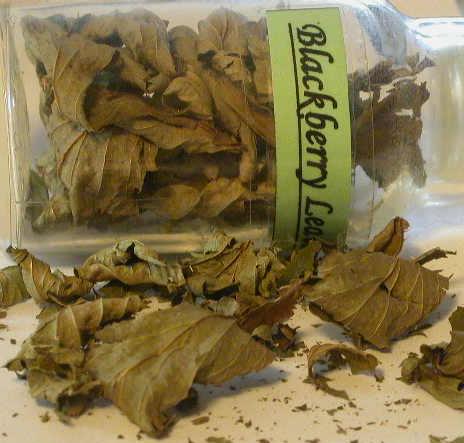
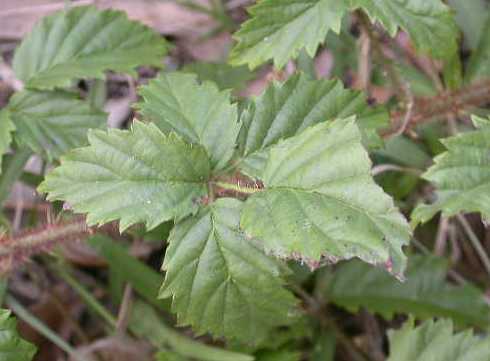
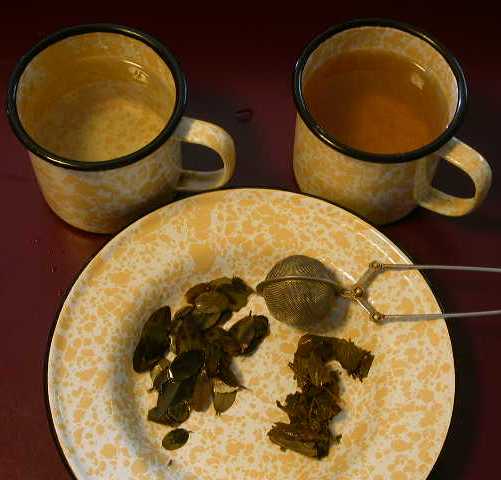
Blackberry Tea:  Pick blackberry leaves (after berries are done!) gently wash in cool water without bruising, pat dry.  If you have a dehydrator, lay leaves out on racks and dry slowly to a nice crumbly-crisp texture.  Oven users, lay leaves on a cookie sheet, set oven to about 200* and bake until dry and crumbly – not burnt!  I try to leave the leaves whole so I can use them in a tea-ball but you can also add them directly to a cup of hot water and then pour through a paper towel, coffee filter or small-hole strainer to remove the leaves.  Use about 2 teaspoons of dried leaves per one cup of boiling water, sweeten (local made/sold honey?) if desired and enjoy!   Store unused leaves in air-tight container (I use a recycled spice jar).  If dried and stored properly the leaves can be kept and used whenever you wish.  If you have raspberry growing naturally – follow these same steps.
Blackberry

Medicinal Uses for Blackberry: Tea made from the leaves, root and even bark (I have only tried and tested leaves) can be cooled and used as an astringent to treat cuts and burns, when used as a drinking tea it can sooth intestinal upsets of diarrhea and dysentery. Chew the fresh green leaves for swollen gums/throat ailments.


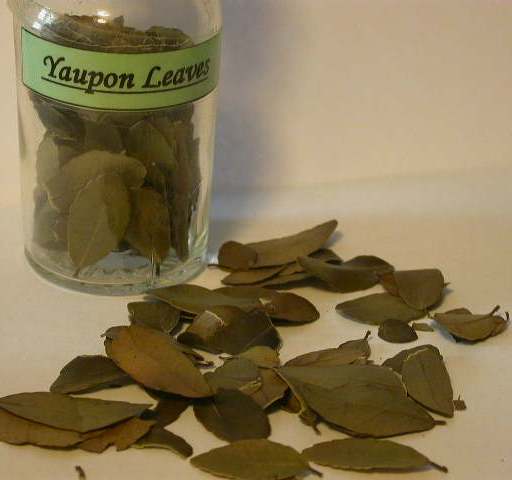
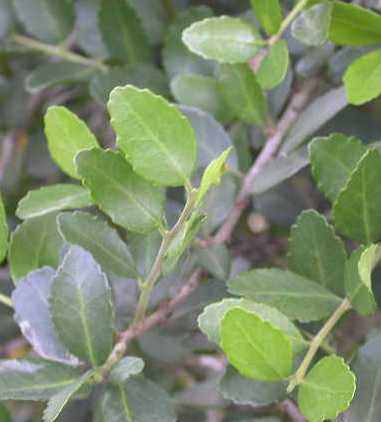
Yaupon Tea:  A very little known diamond in the rough- I was shocked to learn that this native wonder is one of only three species that are natural producers of caffeine other than coffee!  However, be very careful - it got its name for a reason – “Ilex Vomitoria” – the little red berries were used by natives as a purging agent and can cause severe sickness.   This is a wonderful plant and can be easily “tamed” by pruning and easily adapted into a yards landscape as a hedge or let it grow into an attractive winter outdoor tree to provide berries for the native bird species.  In the wild, it is an essential part of the winter diet of the deer.  Ever look closely at the outer leaves and see the ends nibbled away?  Deer.  Anyway, pick the new leaves, vibrant light green the older darker leaves can be very bitter.  It is essential to dry these, do not use raw!  Wash fresh picked leaves, blot dry and dry them as described in the blackberry preparation until they are a nice deep-golden “crunchy” brown.  They do not provide as much caffeine as coffee but it is natural and makes a nice hot cup of tea.  To me, the flavor and appearance is that of green tea.
Other uses of Yaupon Holly:  Very informative! http://plants.usda.gov/plantguide/pdf/cs_ilvo.pdf

Yaupon Holly


Blueberry leaf tea:  Not so readily available here in Texas but something I loved when I was out hunting in the mountains of the extreme North –You might have these plants growing wild or you can buy one to grow if you are in the proper zone for them to thrive.  Pick leaves, wash and steep in hot water.  No need to dry the leaves first, enjoy them fresh!   After being out all day hunting/hiking, on the way back to camp I would pick the leaves and the first thing I would do when we returned to camp was put the water pot back on the fire so I could relax with the soothing soft flavor of the berry that this plant provides.  


Medicinal uses of Blueberry: So many to list but here is a very informative page that gives them ALL!  Headache, intestinal, eyesight, gas, glaucoma, on and on and on… http://www.botanical-online.com/english/medicinalblueberry.htm
The best breakfast I have ever had is that which was made over an open campfire.  Do you have one of those percolator pots that always percolate coffee grounds into your pot of coffee?   Well, I do not have a remedy for that particular problem but I DO have a solution for bitter coffee or no milk for toning down that bitterness…eggshells.  You can save up egg shells at home to take in your camp gear or when making your campfire breakfast, after you crack your eggs open, toss the shells into the percolator (in the liquid, not with the grounds) and let ‘er brew.  Makes a smooth, creamy, non-bitter pot of camp coffee.
Hope you enjoy trying these simple natural pleasures…Whether out on the trail or on the patio, before you attack that annoying “weed” that keeps coming back…grab your regional native plant book to identify it, then research all you can, most of what you will find are the BENEFITS that it is persistently trying to provide.
As always – if you do not know for certain what it is – DO NOT EAT IT!  Some native plants may be edible but some are beneficial in completely other ways and are NOT TO BE EATEN OR CONSUMED IN ANY WAY.  If you cannot identify with certainty from your field guide book, take a sample cutting into your extension office, master gardeners, or even a park ranger for proper ID.  When in doubt, leave it alone!
Meanwhile, I will be out exploring, gathering and conjuring.  Maybe next go-round we will make our own flour (for those campfire pancakes!) from another often overlooked source…more to come!  
Tea Time!  Yaupon Tea on left  Blackberry Tea on right

~Rebecca McPhate TimmEarthly_Epona@msn.com


Here are some book titles on Amazon that I have read and keep in my own personal library- before buying always check first with your public library in the regional/state section!
Native Alternatives to Invasive Species
ISBN: 978-1889538778
A Field Guide to Edible Wild Plants: Eastern and central North America (Peterson Field Guides)
ISBN: 978-0395926222

A Field Guide to Medicinal Plants and Herbs: Of Eastern and Central North America (Peterson Field Guides)

ISBN: 978-0395988145

How to Get Your Lawn off Grass: A North American Guide to Turning Off the Water Tap and Going Native

ISBN: 978-1550172591

Sunday, April 1, 2012

Improvised fish hooks (Guest Article)


Today I am going teach you how to make fishing hooks from the stuff around you. Start looking around for suitable thorns to use. In this article I will be using Wild Orange Thorns. The sharpest and sturdiest the better. Be careful not to dull the sharp tip of the thorns because this makes the hook so much more effective. I started by scraping the thin bark layer off my thorns this is not necessary, You can see how the tree has allowed the tip of the thorn to die so that it is harder and sharper. You need to find the strongest thorn branch possible, look for it to be thick at the base (next to the branch) and thin at the tip the thorns should be facing up. you could whittle it at the top for the string to fit and stay in place.
The thorn in the picture is not attached to the wood...but you could stick it to the wood with a very small amount of Pine tree resin or other glue to make binding the thorn less fiddly
Make a length of very thin cordage or you can just use a plain length of some kind of strong fiber or even a shoelace. Put the thorn through a loop knot on the end of the cordage. Hopefully the following pictures explain themselves and show how to bind the thorn to the wood.
 Continue wrapping the string around the stem of the hook and then to finish it off pass the end underneath the last couple of wraps and pull tight

Finished hook... It would have been better to carve the top of the hook so that it is easier to attach the line. Have fun!

Wednesday, February 29, 2012

Edible Flowers {Guest Article}


Edible Flowers are everywhere…
When we lived in Hawaii we got to eat lots of different types flowers.. They would put flowers in drinks, salads, and even deep fried (you would have thought being from the south I would have already had this one.).. You might be saying “Yuck” but they actual taste good, many different flavors as well… I have to say that my favorite is deep fried squash blossoms “Yummy”…  FYI, there is a drawback to eating the blossoms you get no squash from the plant, after removing the blossom..
Okay, let me get to the many flowers you might run across while out in the woods..
Clover is sweet, anise-like, licorice. Raw flower heads can be difficult to digest.
Dandelions, Flowers are sweetest when picked young. They have a sweet, honey-like flavor. Mature flowers are bitter. Dandelion buds are tastier than the flowers: best to pick these when they are very close to the ground, tightly bunched in the center, and about the size of a small gumball. You can use them in salads or cooked.. (this is the easiest one to try.. everyone has them in their yard. If you put chemicals on your yard, go to a different location to pick these.)
Citrus blossoms,  Use highly scented waxy petals sparingly. Distilled orange flower water is characteristic of Middle Eastern pastries and beverages.
Sunflower,  The flower is best eaten in the bud stage when it tastes similar to artichokes. Once the flower opens, the petals may be used like chrysanthemums, the flavor is distinctly bittersweet. The unopened flower buds can also be steamed like artichokes.
Honeysuckle, Sweet honey flavor. Only the flowers are edible. NOTE: Berries are highly poisonous - Do not eat them!
Yucca Petals The white Yucca flower is crunchy with a mildly sweet taste (a hint of artichoke). in the spring, they can be used in salads and as a garnish.
 http://whatscookingamerica.net/EdibleFlowers/EdibleFlowersMain.htm
Cactus Flowers are Edible The fruits of many cactus species are edible. The juicy, purplish-red fruit of the prickly pear cactus (Opuntia ficus-indica), for example, is commonly found in grocery stores in Mexico and the southwestern United States. Few realize, however, that cactus flowers also make delicious meals and snacks. The flower buds of the barrel cactus (Ferocactus genus) were boiled and eaten in a similar manner to vegetables such as cabbage by the native inhabitants of Arizona, where these thorny plants proliferate. Barrel cactus flowers manifest in a multitude of festive colors including red, orange and yellow.
Cactus Flowers Used as Medicine
Prickly pear flowers
In addition to making wine, prickly pear cactus flowers have been employed for their purported therapeutic benefits. Author Margaret Joan Roberts, in her book "Edible & Medicinal Flowers," reveals that these warm-colored blooms are used in Mexico as a home remedy for relief from itchy insect bites and other stings and scratches. Prickly pear flowers are astringent. Like their associated fruits, they are also high in vitamin C.
Here in the south you can find Prickly Pear jelly, slices, etc…
As for cattails you can eat every bit of this plant.. The cattail is packed full of protein and other nutrients.. It is considered one of the most important wild foods you can eat… go get some and try them out…

Sunday, February 26, 2012

Survival Kit

In this video I go over the basic load out of a grab and go survival kit. This kit at the bare minimum minus the knife and magnesium fire starter cost around 15 dollars to build and will make any emergency night in the woods more comfortable. This is something that should be in a drawer or cupboard that is easy to get to and grab for any emergency or natural disaster. Just throw this bag into your backpack any time you go on a hike go hunting or fishing and if you need to make a emergency night stay you will be set. Any questions just post in the comment section and I will answer them.

Wednesday, February 22, 2012

550 cord storage.

Parachute cord storage. Probably the best way to have easy tangle free storage and deployment. I am working on a how to for tying this. It will work on other rope as well.


Monday, February 20, 2012

Some projects

Here are a couple of pictures from some projects I am working on. Comments are welcome as I am going to try and sell these on etsy to help fund this site. One is a Turks Head bracelet and the other is a key fob. On the key fob I made the top half double and the bottom half single which one would you prefer? Single or Double?

Friday, February 17, 2012

Fillet a Fish

This is a Guest Article written by my brother Corbin.

For someone in the forest near a river/lake/stream a major priority is
food. To catch a fish you need bait. In fresh water worms,bread, and
various bugs can be used. If you lack a fishing rod or net the best
substitute could be any form of string material and a stick/limb at
about 7-12 feet that wont break easily. If you lack hooks for a fish
to bite find some wood or bone, anything that can be
carved/ground/whittled down to the shape of a hook and sharp enough to
pierce the scales. If by any luck or use of manliness you find a fish
on the end of a line without a reel pull the string down to your waist
and pull as hard and fast as humanly possible. When your fish is on
the shore and dead, it's time to figure out how to skin/scale it.
first you'll need a knife that can be used to fillet the fish. Once
you obtain a knife/razor, put the blade next to the gills and push
down, Without cutting the fish in half, and slide it toward the tail.
Cut along the side of the spine without cutting off at the tail, leave
a little skin attaching the fillet and the fish together. Flip the
skin over so the meat is facing up and slide the knife along the
bottom of the meat between it and the skin. After a little
blood,sweat,and tears you have a cook-able fillet! 


If you prefer skinning the fish here is how
"Cut the skin behind the head and pectoral fins. Use pliers to remove
the cut skin from the catfish, starting at the head and pulling toward
the tail. Then, grasp the head of the fish with one hand and the body
with the other. Using both hands, break the backbone of the catfish at
the head, and then pull the head and guts away from the skinned body."
[Source: Take Me Fishing]


this is a catfish be careful for the spines in their fins


Wednesday, February 8, 2012

Next video ideas

Taking votes for my next video. Do y'all want another bracelet video or do y'all want a how to on something else?

Tuesday, February 7, 2012

Survival Bracelets Vid1


Here is the first video of the series for uses of the survival bracelets. Any questions feel free to post and I will answer to the best I can. 

Saturday, February 4, 2012

Etsy Store

I have an Etsy store now as well to sell different things that I make that will make life easier in a time of need. Such as mini first aid kits, mini survival kits and 550/Para chord survival bracelets and key fobs.
http://www.etsy.com/shop/sparky25c

Tuesday, January 31, 2012

WELCOME!

Hello and welcome to Average Joe's Survival Guide. In future posts you can expect to read watch and learn about different survival methods. Along with product reviews and other useful information pertaining to the great and vast outdoors and at home. I plan on having the first How To article up in about a week and a half or sooner so please stop back by!


Have a Good one!